 Hybrid Battle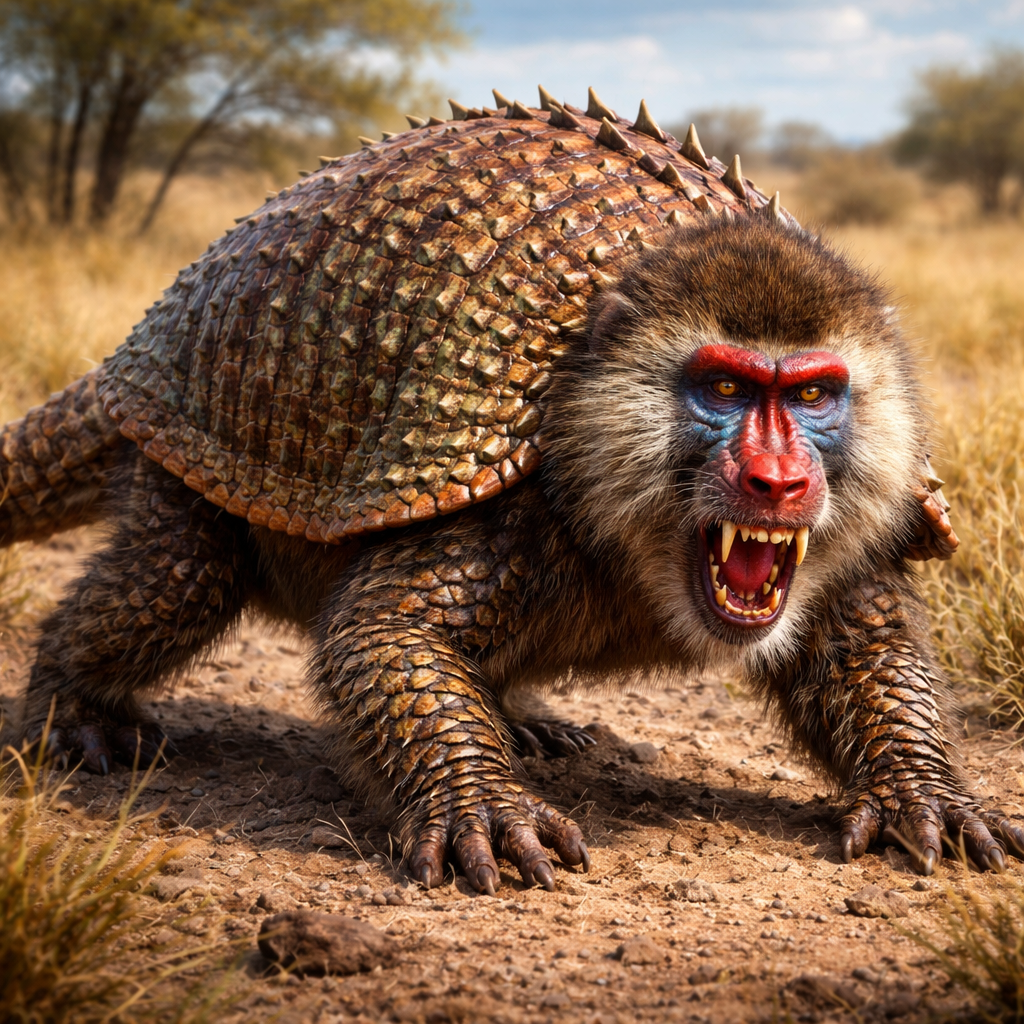
Babarmadillo
A hybrid of Baboon + Armadillo
The Babarmadillo is a fascinating hybrid creature, showcasing the vibrant, expressive face and social behavior of the baboon, combined with the robust armor and unique body structure of the armadillo. With a length of approximately 1.5 meters, the Babarmadillo features a rounded, armored shell that reflects hues of earthy browns and greens, providing excellent camouflage in its natural habitat. Its agile limbs and powerful claws enable it to dig and forage, while its expressive eyes and powerful jaw highlight its baboon lineage.
Special Abilities
Armored Charge
The Babarmadillo charges at its opponent, using its armored shell to inflict damage while also knocking them back.
From the ArmadilloReal-world basis: The physical structure of the armadillo's shell allows for a powerful, defensive charge that can disorient adversaries.
Furious Bite
The Babarmadillo delivers a powerful bite, utilizing its strong jaw and sharp teeth to inflict significant damage.
From the BaboonReal-world basis: Baboons possess strong jaw muscles, allowing them to exert considerable force when biting.
Shell Shield
The Babarmadillo curls into a ball, using its hard shell to deflect attacks and protect vital organs.
From the ArmadilloReal-world basis: The armadillo's ability to curl into a ball provides a natural defense mechanism against predators.
Social Distraction
Utilizing its social nature, the Babarmadillo can create a diversion by making loud calls or gestures to distract predators.
From the BaboonReal-world basis: Baboons are known for their social communication and can effectively distract threats with their vocalizations.
Habitat: The Babarmadillo thrives in semi-arid grasslands and scrublands, often found near rocky outcrops and sparse forests. It prefers environments with plenty of burrowing opportunities and a mix of open ground for foraging. Diet: The Babarmadillo is an omnivore, primarily feeding on a diet of roots, tubers, insects, and small vertebrates. It uses its strong claws to dig into the ground for food, showcasing a foraging behavior similar to that of both parent species.