 Hybrid Battle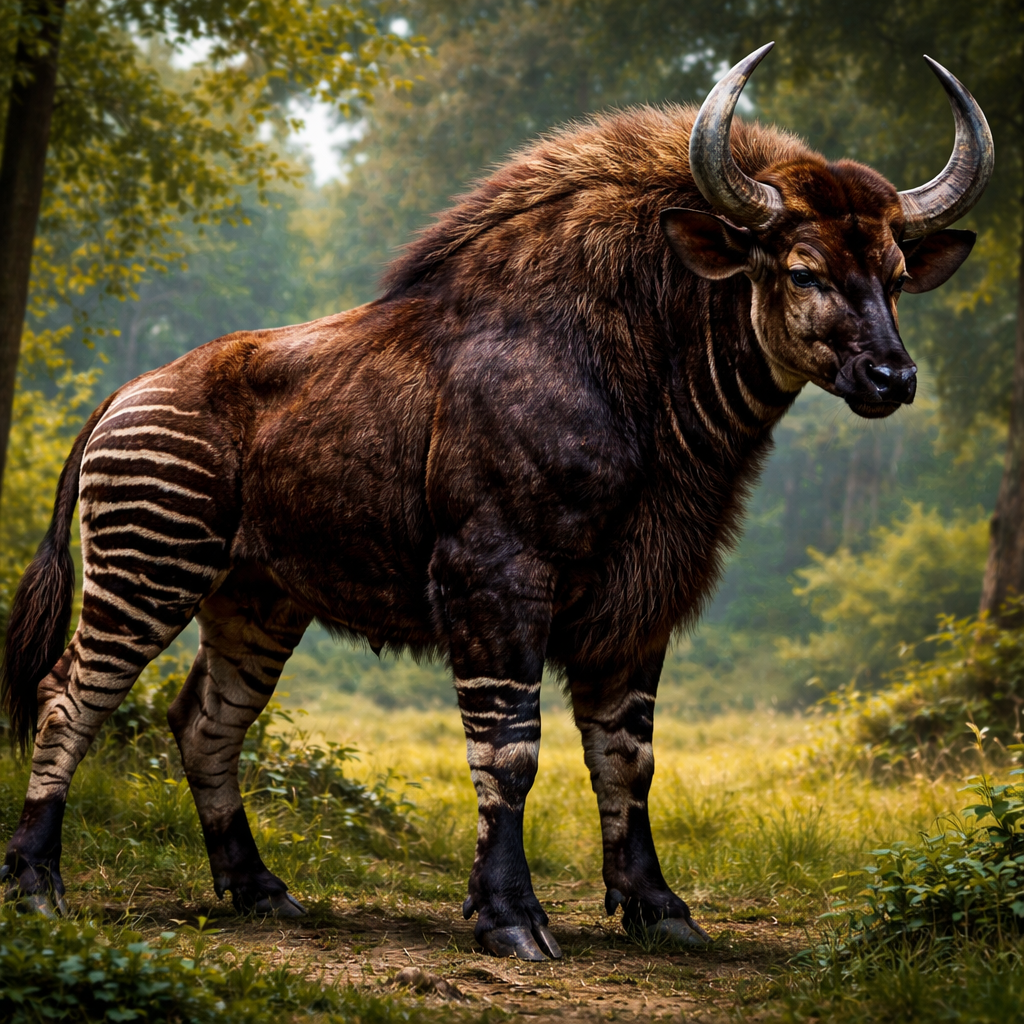
Okibison
A hybrid of Okapi + Bison
The Okibison (Okapi bisonicus) is a unique mammal exhibiting a blend of the Okapi's elegant form and the robust structure of a bison. It possesses the elongated neck and dark striped hindquarters of the Okapi, complemented by the massive, muscular build and shaggy coat of the bison. Standing approximately 1.8 meters tall at the shoulder, the Okibison has a striking appearance with its dark brown body, white stripes on its legs, and large, curved horns reminiscent of a bison.
Special Abilities
Horn Charge
The Okibison lunges forward, using its massive horns to impale and push back enemies, delivering a powerful blow.
From the BisonReal-world basis: The strength and mass of the Okibison allow it to generate significant force during a charge, akin to the bison's well-known attacking behavior.
Tail Whip
With a swift motion, the Okibison swings its sturdy tail to strike opponents, causing disorientation and mild injury.
From the OkapiReal-world basis: The tail's flexibility and strength provide an unexpected attack vector, similar to the Okapi's defensive maneuvers.
Thick Hide
The Okibison's thick, shaggy fur and tough skin provide excellent protection against physical attacks and environmental hazards.
From the BisonReal-world basis: The evolutionary adaptations of the bison’s hide allow the Okibison to withstand harsh conditions and physical confrontations.
Camouflage
Utilizing its unique coloration and patterns, the Okibison can blend into its forested environment, evading predators.
From the OkapiReal-world basis: The Okapi's natural camouflage techniques are adapted in the Okibison, enhancing its survival in dense habitats.
Habitat: The Okibison thrives in dense tropical forests and adjacent grasslands, where it can navigate through thick vegetation while having access to open areas for grazing. It prefers regions with abundant water sources and a rich diversity of flora. Diet: As a herbivore, the Okibison primarily feeds on a variety of leaves, grasses, and fruits, utilizing its long tongue to reach foliage high in trees, similar to its Okapi lineage, while also grazing on the ground like a bison.